

Constellations and AsterismsA constellation is a grouping of stars that appears to form a figure when one imagines lines connecting them. The stars of a constellation seem to lie close together upon the celestial sphere in a recognisable configuration. Constellations bear the names that human imagination has attributed to these shapes. Even in antiquity, people discerned certain patterns in the night sky to which they ascribed significance or power. Typically, one or more bright stars are situated within the figure. In most instances, however, these patterns are merely an illusion: stars that appear close together from our vantage point on Earth are in reality often separated by vast and differing distances, unlike, for example, the stars within open Clusters. Like a constellation, an asterism is only an apparent grouping, meaning that its stars are likewise not necessarily related in physical space and are usually located at very different distances from Earth. Asterisms are therefore collections of stars that do not belong to the officially recognised constellations. Nevertheless, many constellations have their origins in earlier asterisms. Only later were constellations defined as specific regions of the sky rather than as particular figures. The stars forming an asterism need not belong to a single constellation (as in the “Saucepan”), but may be drawn from several different constellations (as in the Summer Triangle). Corona Borealis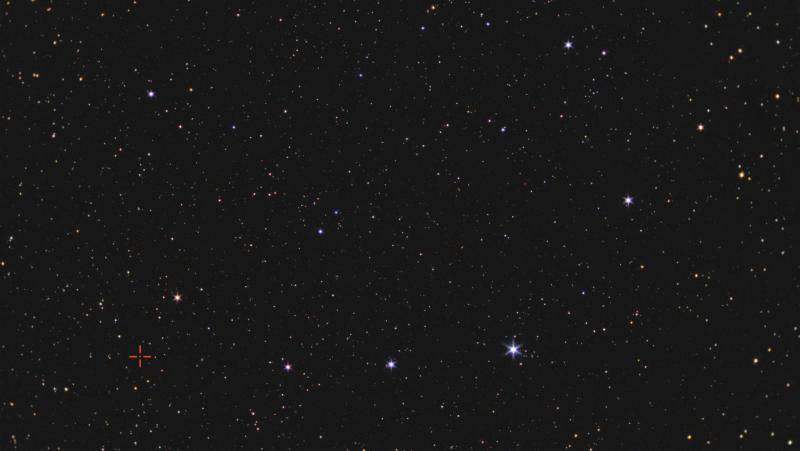 Figure 1: Corona Borealis as imaged on 24 August 2026, the red cross indicates the recurring nova T CrB. On 7 April 2026 I began participating in an AAVSO project using the SHG700 Spectroscope. The chosen target was T CrB, currently a magnitude 10–11 star located at a distance of 2,986.777 light‑years in Corona Borealis. From that moment on I try to image T CrB at every clear night occasion by taking ten subs of 600 seconds each with a 600 lpmm grating (R = 1600). While the scientific data is being captured, a ZWO ASI290MC (at gain 110) fitted with a 25 mm focal‑length CCTV lens (at f/1.4) records 90 subs of 20 seconds, giving a total of 30 minutes of data. The recording is processed as standard deep‑sky data in APP, PSP, and Topaz. Despite the modest quality of the lens, the result is quite reasonable. The image covers an area of approximately 12.5 × 7 degrees. The seven principal stars of the constellation are clearly visible. At the lower left, a red cross marks the position of T CrB, which is expected to produce a nova in the coming months. When it does, it will be roughly as bright as Alphecca, the 2.2‑magnitude star in the constellation (the largest in the image). Click here for the full image. Kembel's Cascade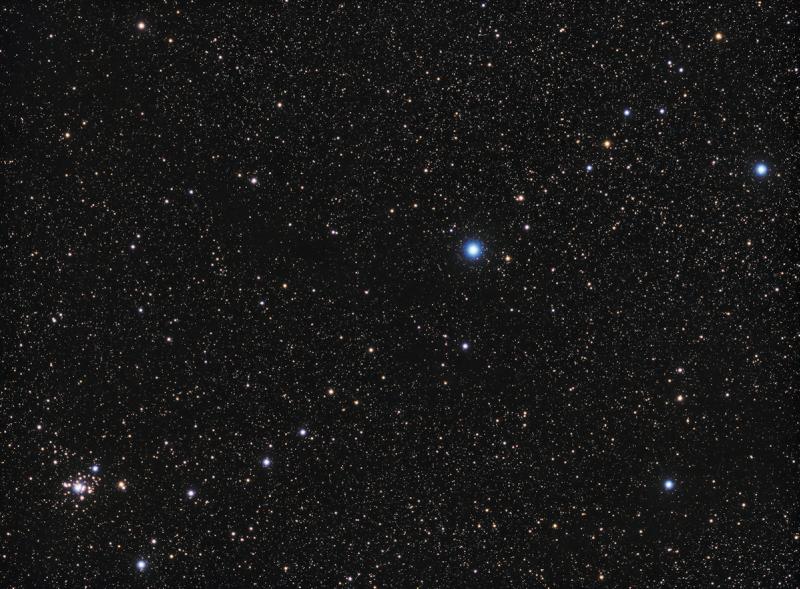 Figure 2: Kembel's Cascade and NGC1502 as imaged with the Esprit 80ED on 14 September 2023. On 14 September 2023 I imaged Kemble's Cascade that leads to the open cluster NGC1502 at approximately 3500 light-years in the direction of the constellation of Camelopardalis. NGC1502, at the lower left corner of the image, was discovered by William Herschel on 3 November 1787. The Cascade was introduced by Father Lucian Kemble (1922–1999), a Franciscan friar and amateur astronomer who wrote a letter about it to Walter Scott Houston, an American popularizer of amateur astronomy. Kemble called it "a beautiful cascade of faint stars tumbling from the northwest down to the open cluster NGC 1502". Houston in turn wrote an article about the asterism in Sky & Telescope and coined the asterism Kemble's Cascade. Imaging was done in LRGB, a total of six hours and forty minutes of data was collected for this galaxy:
Captured with the SkyWatcher Esprit 80ED in combination with the ZWO EFW filter wheel, ZWO LRGB filters and ZWO ASI1600MM Pro Cool camera @ -10°C. Processing in APP, post-processing in Siril, PSP and Topaz DeNoise AI. Click here for the full image. If you have any questions and/or remarks please let me know. |
InFINNity Deck... Astrophotography... Astro-Software... Astro Reach-out... Equipment... White papers...
Deep Sky... Solar system (Main)... Solar System (Asteroids)... Solar System (Meteors)... Solar System (Comets)... Man-made objects...
Nebula Planetary Nebula Clusters Galaxies Constellations & Asterisms